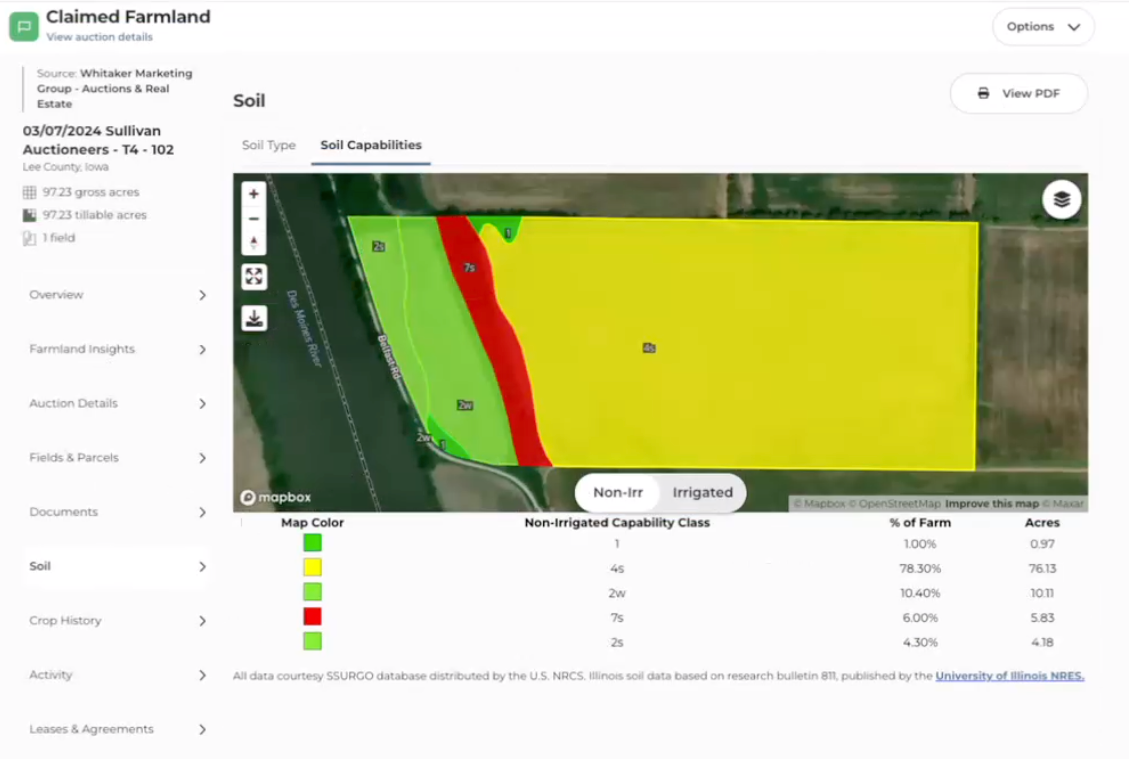

Class 2: soils have moderate limitations that restrict the choice of plants or that require moderate conservation practices.
Class 3: soils have severe limitations that restrict the choice of plants or that require special conservation practices, or both.
Class 4: soils have very severe limitations that restrict the choice of plants or that require very careful management, or both.
Class 5: soils are subject to little or no erosion but have other limitations, impractical to remove, that restrict their use mainly to pasture, rangeland, forestland, or wildlife habitat.
Class 6: soils have severe limitations that make them generally unsuitable for cultivation and that restrict their use mainly to pasture, rangeland, forestland, or wildlife habitat.
Class 7: soils have very severe limitations that make them unsuitable for cultivation and that restrict their use mainly to grazing, forestland, or wildlife habitat.
Class 8: soils and miscellaneous areas have limitations that preclude commercial plant production and that restrict their use to recreational purposes, wildlife habitat, watershed, or aesthetic purposes. Capability Subclass Capability subclasses are soil groups within a class. They are designated by adding the class letter to the class number (example 2w). Soil class 1 has no subclasses as there are few limitations to this soil class. Subclass e: soils for which the susceptibility to erosion is the dominant problem or hazard affecting their use. Erosion susceptibility and past erosion damage are the major soil factors that affect soils in this subclass.
Subclass w: soils for which excess water is the dominant hazard or limitation affecting their use. Poor soil drainage, wetness, a high water table, and overflow are the factors that affect soils in this subclass.
Subclass s: soils that have soil limitations within the rooting zone, such as shallowness of the rooting zone, stones, low moisture-holding capacity, low fertility that is difficult to correct, and salinity or sodium content.
Subclass c: soils which climate (the temperature or lack of moisture) is the major hazard or limitation affecting their use.